

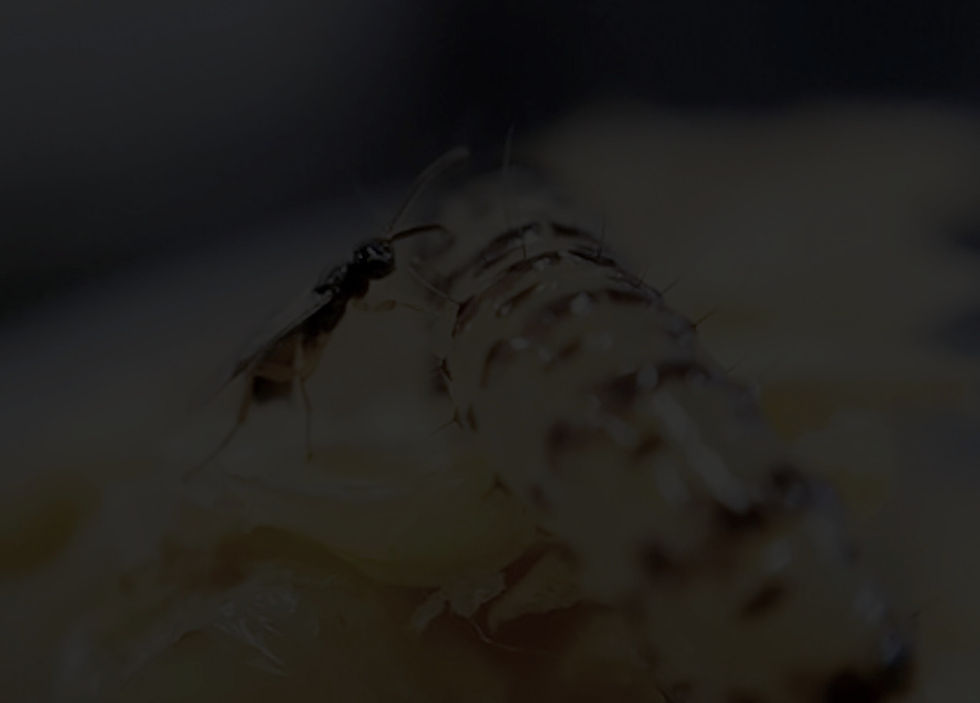
Created in 2003 at the Department of Biotechnology, Genetics, and Cell Biology (DBC) at the State University of Maringá (UEM), the Laboratory of Biological Control and Bioprospection of Insects, conducts research on insects.
Initially, the laboratory focused on the rearing of different Drosophila species, used during genetics lessons. The rearing and maintenance were supervised by Dr. Satiko Nanya. t the same time, a mass rearing of Diatraea saccharalis was maintained by Dr. Helio Conte. the establishment of the Postgraduate Program in Environmental Biotechnology (PBA) in 2014, the laboratory expanded its research to include different insect species and broadened its focus to biological control and bioprospection of insects. In 2026, Dr. Adriana A. S. Gigliolli was appointed to a permanent position in the department and became one of the researchers responsible for the laboratory.
In the laboratory, insects of various orders, such as Diptera, Lepidoptera, Neuroptera, and Phasmatodea, are maintained in artificial or natural diets. For example, Diatraea saccharalis (Fabricius, 1794) (Lepidoptera: Crambidae), Chrysomya megacephala (Fabricius, 1794) (Diptera: Calliphoridae), Hermetia illucens (Linnaeus, 1758) (Diptera: Stratiomyidae), Ceraeochrysa claveri (Návas, 1911) (Neuroptera: Chrysopidae), Chrysoperla externa Hagen, 1861, Chrysoperla argentina (González-Olazo & Reguilón, 2002) (Neuroptera: Chrysopidae), Arumatia dubia (Phasmatodea: Phasmatidae), Anticarsia gemmatalis Hübner, 1818, Chrysodeixis includens (Walker, 1858), Spodoptera frugiperda (Smith, 1797), Spodoptera eridanea (Stoll, 1781), Spodoptera cosmioides (Walker, 1858), and Helicoverpa armigera (Hübner, 1808) (all Lepidoptera: Noctuidae). The mass rearing activities are carried out by MSc and PhD students affiliated with our research group.
Almost all specimens are used in graduate projects, PIBIC, PIC, undergraduate theses (TCC), specialization courses, and undergraduate subjects.
Our research focuses on bioprospection; morphological studies of internal and external structures; histology and ultrastructure analysis (SEM and TEM); and biological control using entomopathogens, essential oils, and inert substances. We also provide lectures for the community and offer short courses at scientific events.